
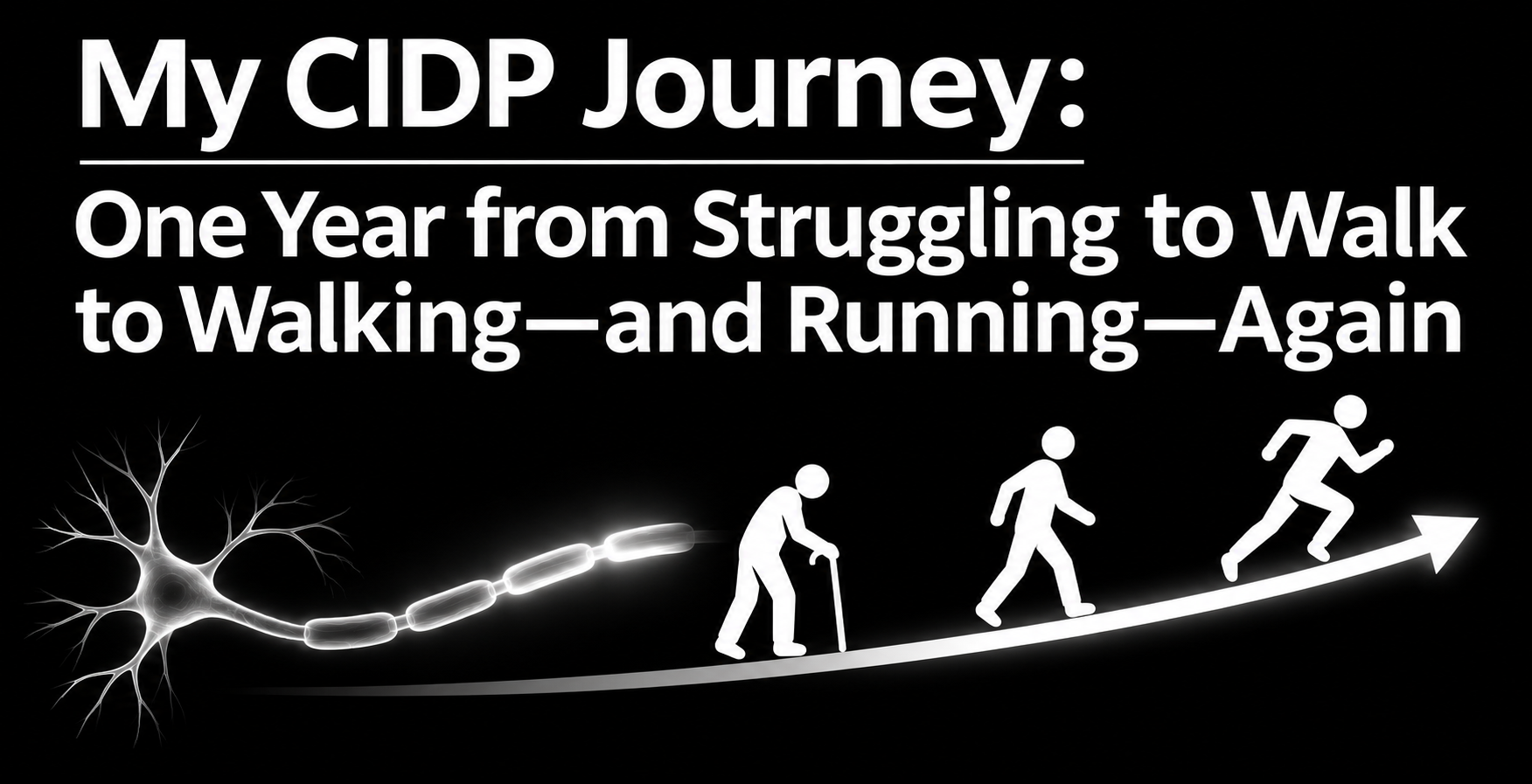
An account of my experience with Chronic Inflammatory Demyelinating Polyneuropathy (CIDP), from severe walking difficulties to gradually regaining my mobility.
Introduction — A Completely Different Life from One Year Ago
In late November 2026, I attended a reunion of my university club. Earlier that day, I had visited the National Museum of Nature and Science in Ueno, Tokyo, and spent much of the day walking around. When I checked my step count afterward, I was surprised to find that I had walked 14,000 steps. It had been quite an active day, yet I was able to walk relatively smoothly without using a cane.
Exactly one year earlier, in late November 2025, I had attended the same university club reunion. At that time, walking was extremely difficult, even with a cane. I could not lift the front of my feet properly, and I was constantly at risk of tripping and falling. Even when I tried to walk normally, my feet would not move forward as I wanted them to. Stairs at railway stations and crowded places were particularly challenging.
Just one year later, in November 2026, my condition had improved enough that I could walk without a cane, cheer for the Chunichi Dragons baseball team from the outfield cheering section, visit museums, take trains, and attend reunions with old friends.
Of course, I have not completely returned to the physical condition I enjoyed before becoming ill. I still experience unusual sensations in the soles of my feet, and my ankles and toes sometimes feel strangely stiff. Nevertheless, my ability to walk has improved dramatically over the past year. What makes me happiest is that I have gone from a situation where walking itself was an exhausting task to one where I can walk in order to do the things I want to do.
The disease I have been dealing with is called Chronic Inflammatory Demyelinating Polyneuropathy, or CIDP. It is a neurological disorder that affects the peripheral nerves and can cause muscle weakness, numbness, sensory disturbances, and difficulties with movement. Symptoms, responses to treatment, and recovery outcomes vary considerably from person to person.
Before I began treatment in February 2026, I knew very little about this disease. In fact, my symptoms may have started well before November 2025, although I cannot determine exactly when CIDP first developed.
In this article, I would like to look back primarily at the year between November 2025 and November 2026, while also describing the symptoms that began earlier, the process that led to my diagnosis, my hospital treatment, and the gradual recovery I have experienced since then. I hope my experience may be helpful to others living with CIDP, as well as people who are struggling with unexplained muscle weakness or numbness.
1. My Legs Did Not Recover Even After Spinal Surgery
My story goes back to December 2023. When I tried to run even a short distance, I experienced severe pain in my lower back. From that point onward, I was no longer able to run.
For a while, I tried to manage the symptoms through manual therapy and other conservative measures. However, the numbness in my legs became increasingly severe. Eventually, the areas below my ankles became almost completely numb, lost much of their sensation, and became difficult to move.
By December 2024, I could no longer manage the condition on my own and visited the orthopedic department of a major hospital. I was diagnosed with lumbar spinal stenosis and underwent surgery at the end of January 2025.
Lumbar spinal stenosis is a condition in which the space around the nerves in the lower spine becomes narrowed, potentially causing back pain, leg pain, numbness, and muscle weakness. Following surgery, my lower back pain and sciatica improved considerably. This was a tremendous relief, and I was grateful that the operation had successfully addressed those symptoms.
However, one serious problem remained. I still could not move my ankles and feet properly. About six months after surgery, these difficulties became even worse. In July 2025, I fell and suffered a fracture, which led to a period of using crutches.
One of the most troublesome symptoms was my inability to lift my feet upward at the ankles, a movement known as dorsiflexion. When people walk, they naturally lift the front of their feet so that their toes do not catch on the ground. Most of us never think about this movement until we lose the ability to perform it.
In my case, both ankles were weak, causing a condition known as foot drop. My toes tended to point downward, and I could not extend them upward properly. I also experienced severe sensory disturbances in the soles of my feet and toes. Even when my feet were touching the ground, I could barely feel the surface beneath them. The numbness persisted.
I was not completely unable to walk, but I had to compensate by using my knees and hips more than usual to lift my feet and avoid tripping. Although I tried to walk normally, my gait was clearly abnormal. After the fracture, I began using a cane for safety, but I still fell repeatedly.
Standing still was also difficult. I could sometimes maintain my balance while moving, but once I stopped walking, my body became unstable. There was a period when I struggled to remain standing for even ten seconds.
Why could I no longer move my ankles and toes, even though the surgery had relieved my back pain? Would my condition improve with time? Or had my nerves already been damaged beyond recovery?
These questions remained with me throughout 2025.
Looking back, it is possible that CIDP-related peripheral nerve damage was already contributing to my symptoms. However, I cannot determine how much of my disability was caused by lumbar spinal stenosis and how much was caused by CIDP. What I do know is that spinal surgery alone did not resolve the weakness and sensory problems in my feet.
2. November 2025 — Attending My University Reunion with a Cane
In November 2025, I attended a reunion of my university club. It was an opportunity to see old friends, and I was determined to participate. By then, however, walking without a cane had become extremely difficult.
Because my ankles did not move properly, I had to walk slowly and carefully, concentrating on every step to avoid catching my toes on the ground. Even traveling a relatively short distance was exhausting. People around me walked normally, while I struggled to keep moving. Roads leading to railway stations and corridors inside buildings, which I had once taken for granted, had become major obstacles.
Nevertheless, I still had to work and manage my daily life. My professional work includes business consulting, and I sometimes need to visit clients and travel by train. When walking becomes difficult, the consequences go far beyond a decline in physical fitness. I had to think carefully about how to arrange meetings, how to travel, where I could rest, and how much luggage I could safely carry.
I was also working as a university researcher alongside my consulting activities. Eventually, I had to resign from that position because I could no longer tolerate the physical demands of commuting.
The ordinary routines of my life were gradually becoming more difficult. Looking back now, the reunion in November 2025 has become an important reference point for understanding how severely my mobility had deteriorated. Exactly one year later, I would attend the same reunion in a remarkably different physical condition.
3. February 2026 — Learning That I Might Have CIDP
A major turning point came in February 2026.
An orthopedic specialist referred me to a neurologist, who conducted a series of detailed examinations. These tests raised the possibility that I had CIDP.
Before the consultation, I had also watched an NHK television program called Torisetsu Show, which discussed how numbness in the feet might sometimes be related to neurological diseases. That program encouraged me to investigate my symptoms more thoroughly.
CIDP stands for Chronic Inflammatory Demyelinating Polyneuropathy. It is an immune-mediated disorder affecting the peripheral nerves, which carry signals between the brain, spinal cord, muscles, and sensory receptors throughout the body.
Many peripheral nerve fibers are surrounded by a protective insulating layer called myelin. In CIDP, abnormal immune activity can damage this layer, interfering with the transmission of nerve signals. As a result, the muscles may not receive proper instructions to move, while sensory information from the hands and feet may not reach the nervous system normally.
My examinations revealed several abnormalities. The tendon reflexes in both legs were absent, and my ability to detect vibration was reduced. Nerve conduction studies showed that electrical signals traveling toward my feet were severely impaired.
The neurologist also explained that, in addition to demyelination, there might be damage to the axons—the nerve fibers themselves.
This explanation was extremely important to me. For the first time, I had a possible explanation for why my feet had remained so weak even after spinal surgery.
Of course, I still did not know how much recovery I could expect. Nevertheless, after a long period of uncertainty, there was finally a possible diagnosis and a treatment plan.
In early February, I was admitted to the hospital to receive intravenous immunoglobulin therapy, commonly known as IVIg.
4. Five Days of IVIg Treatment — The First Improvement Was in the Soles of My Feet
IVIg involves administering immunoglobulin through an intravenous infusion. I received this treatment for five consecutive days.
At the beginning of my hospitalization, sensation in the soles of my feet was extremely poor. To track changes, I began using my own subjective scale from 0 to 10, with 10 representing the normal sensation I remembered from before my illness.
Before treatment, I would have rated the sensation in my soles at less than 1. I knew that my feet were touching the floor, but I could not naturally feel the ground beneath them.
Then, just a few days after treatment began, something unexpected happened. I started to feel sensations returning to the soles of my feet.
Initially, I estimated the sensation at around 2 out of 10. A few days later, it seemed to have improved to around 4.
I was genuinely surprised. My feet had felt almost numb for such a long time that even this partial return of sensation seemed remarkable.
These numbers were not the results of a standardized medical examination. They were simply my personal way of describing the changes I felt. Nevertheless, the difference between before and after treatment was unmistakable to me.
My muscle strength, however, did not recover nearly as quickly.
Although sensation in my soles had improved, I still could barely lift my feet at the ankles. Extending my big toes upward remained extremely difficult. Standing on my toes was completely impossible.
This experience taught me something important: improvements in sensation and improvements in voluntary muscle movement do not necessarily occur at the same pace.
I also participated in rehabilitation during my hospital stay. I repeatedly walked along the hospital corridors and practiced climbing and descending stairs. At that time, even going up or down approximately 11 steps required me to touch a wall or handrail for balance.
Because I could not move my ankles properly, I had to compensate with other parts of my body while walking. Nevertheless, the improved sensation beneath my feet helped me feel more stable than before treatment.
After a hospital stay of just under two weeks, I was discharged in the second half of February. I was delighted to return home, but I also realized that a long rehabilitation process still lay ahead.
5. After Discharge — Measuring How Long It Took Me to Walk 700 Meters
After leaving the hospital, I decided to establish a simple benchmark for my walking ability: how long it took me to walk approximately 700 meters from my home to a nearby railway station.
The conditions were not identical every time, but it was a familiar route that allowed me to track changes in my everyday mobility.
Before hospitalization, I had recorded a time of approximately 19 minutes for this distance. By March, after treatment, I could complete the walk in around 13 minutes and 30 seconds. Over the following weeks, the time gradually decreased to 13 minutes and then 12 minutes.
| Period | Time to Walk Approximately 700 Meters |
|---|---|
| Before hospitalization | Approximately 19 minutes |
| Early to mid-March 2026 | Approximately 13 minutes 30 seconds |
| Mid-March 2026 | Approximately 13 minutes |
| Late March 2026 | Approximately 12 minutes |
| October 18, 2026 | 10 minutes 00 seconds |
Note: The distance and some dates are approximate. These measurements were personal observations under everyday conditions, not standardized clinical walking tests.
By October, I could walk the same approximate distance in 10 minutes, compared with 19 minutes before hospitalization. My walking time had been reduced by almost half.
Initially, I used an ankle-foot orthosis (AFO) to support my ankle and prevent my toes from catching on the ground. Gradually, I became less dependent on the brace.
Even more encouraging than the improvement in walking speed was the change in my gait. I no longer needed to lift my knees excessively or swing my legs forward from the hips to the same extent. Walking began to feel more natural, and the constant need to concentrate on avoiding a fall gradually diminished.
However, improved walking speed did not mean that my ankle muscles had fully recovered. At that stage, standing on my toes remained difficult, and numbness and unusual sensations persisted in the soles of my feet.
After discharge, I also began maintenance treatment with a medication called Hyfudra in Japan, corresponding to VYVGART Hytrulo (efgartigimod alfa and hyaluronidase) internationally. My treatment did not end with the five days of IVIg. I needed ongoing management of CIDP, and I feel that this maintenance therapy has helped support my return to everyday activities.
6. My First Attempt at Jogging — Like an Early Version of ASIMO
Several months after leaving the hospital, I decided to try jogging a little.
Of course, I was still far from being able to run normally. My ankles remained weak, and I could not move my toes properly. Nevertheless, I wondered whether I might be able to jog for just ten steps.
When I tried, I discovered that I could manage something resembling a jog. My movements were extremely awkward, though. My feet did not swing far forward, and I took very short steps, landing close to my body.
I could not help thinking that I resembled an early version of ASIMO, Honda’s humanoid walking robot.
“Just like the first-generation ASIMO,” I thought, laughing a little at my own movements.
Despite the awkwardness, it was a wonderful moment for me. For months, running had been completely beyond my capabilities. Now, even if it was only ten steps, I could jog again.
Unfortunately, I became a little too enthusiastic. Excited by my progress, I continued walking and trying short bursts of jogging. After covering a total distance of approximately four kilometers, I caught the toes of my left foot on the ground and fell.
Fortunately, I did not hit my head. I escaped with a scraped knee, but the experience taught me an important lesson.
Being able to perform a movement is not the same as being able to perform it safely when tired.
Even if my ankle strength had improved, accumulated fatigue could still interfere with my ability to lift my feet. Progress was exciting, but pushing too hard could lead to another fall.
After that incident, I became much more careful about increasing my activity level and began paying closer attention to how long fatigue remained after exercise.
7. Gradually Leaving My Ankle Brace Behind and Returning to Work and Everyday Activities
During the spring and summer of 2026, my range of activities gradually expanded. Initially, I walked longer distances while wearing my ankle brace. Eventually, I became able to walk shorter distances without it.
I also started going out without a cane more frequently.
I attended baseball games, traveled by train to visit clients, and resumed activities that had once been part of my normal life. Little by little, I began to regain confidence in my ability to walk.
However, the difficulties had not disappeared.
When I walked long distances without my brace, I sometimes developed severe muscle soreness around my ankles and shins.
In September, for example, I carried a heavy backpack containing two laptop computers and other equipment while walking approximately 9,000 steps in a single day. Afterward, I experienced significant muscle soreness, particularly along the outer portions of my lower legs near the ankles.
Previously, when I walked around 10,000 steps while wearing my brace, my entire legs tended to feel tired. After I stopped relying on the brace, I noticed that the strain seemed more concentrated around the ankles.
One possible explanation was that muscles which had previously been underused were now becoming more active. However, I cannot say exactly what was happening within my muscles and nerves.
What mattered was that the ability to walk in everyday life and the endurance required to walk for long periods were still very different things.
I learned to reduce exercise on days when I had many work commitments, consider alternative transportation when carrying heavy luggage, and avoid overexertion when fatigue remained.
These were things I had rarely needed to think about before my illness.
Nevertheless, the amount of time I could spend without a brace continued to increase, and the periods during which I avoided falling became longer. This was a tremendous source of reassurance.
8. Nine Months Later — My Ankles Could Finally Lift My Body Again
In November 2026, I experienced another encouraging improvement.
I could finally rise onto my toes a little.
At the beginning of my hospitalization in February, I had been completely unable to stand on my toes. No matter how hard I tried to activate my calf muscles, I could not lift my body upward.
Gradually, I became able to raise my heels slightly while holding onto something. Later, I could perform the movement with only light contact against a wall or handrail.
Then, on November 17, I managed to rise onto the balls of both feet without putting my weight on a wall or handrail.
My heels rose only about two centimeters, and I could maintain the position for only around one second.
For a healthy person, this might seem like a trivial movement. For me, however, it represented an enormous achievement.
Something I had been completely unable to do nine months earlier had finally become possible.
My ability to point my feet downward at the ankles, known as plantarflexion, had improved alongside my ability to lift them upward, or dorsiflexion. I could also extend my toes upward more effectively than before.
In addition, I had become able to climb and descend approximately 40 stairs without supporting my body weight on a handrail.
Of course, I still use handrails when stairs are crowded. There is no reason to take unnecessary risks and fall. Even so, considering that I had been practicing on just 11 steps during my hospitalization, I felt that I had come a very long way.
In October, I also attempted 50 consecutive jogging steps. I managed to complete them without tripping, although I was extremely tired afterward. Interestingly, I felt that my breathing and cardiovascular endurance were more limiting than my leg muscles.
Earlier in the year, running had been impossible because my feet simply would not move as I wanted them to. Now I could jog a short distance and begin thinking about how to make that movement easier and more sustainable.
I am still far from the physical condition I enjoyed before becoming ill, but I can feel that my recovery is continuing. I have even regained enough stability to practice tennis by hitting balls against a wall.
9. The Numbness Has Improved, but My Feet Still Feel Strange
So far, this story may sound as though I have almost completely recovered. Unfortunately, that is not the case.
I still experience symptoms, particularly in the soles of my feet.
At the beginning of hospitalization, sensation in my soles was almost absent. After IVIg treatment, I began to feel various unusual sensations as some feeling returned.
At first, there was a restless, tingling sensation. Sometimes my soles felt as though they had become unusually thick. At other times, they seemed swollen, even though there was no visible swelling.
Later, the sensation changed again. Walking on the floor sometimes felt as though I were stepping on a rough, uneven, or pebbly surface.
As of November 2026, the numbness itself has decreased considerably. However, the unusual rough sensation in my soles remains. When I gently rub the tops of my feet, I still experience a numb or tingling feeling.
Recently, my ankles and toes have also begun to feel somewhat stiff. Yet the actual movement of my ankles has continued to improve. I cannot tell whether this feeling of stiffness comes from my muscles and tendons or from abnormal sensory signals in the nerves.
My experience has shown me that improving muscle function does not necessarily mean that normal sensation will return at the same pace.
At least in my case, the recovery of ankle movement and the changes in sensation in my feet have followed very different patterns.
I still do not know how much further my sensory symptoms will improve.
10. November 2026 — Returning to My University Reunion
And so, in late November 2026, I attended another reunion of my university club.
Before the gathering, I visited a museum and spent much of the day walking. By the end of the day, I had accumulated 14,000 steps.
I had managed all of this without using a cane.
At the reunion one year earlier, even walking with a cane had been extremely difficult. Now I could walk much more naturally.
It was the same season, the same university club, and the same opportunity to meet old friends. Yet my physical condition was remarkably different.
The year had not been easy. I had experienced falls and a fracture, endured muscle soreness, and struggled with persistent sensory disturbances. There were times when I worried that the strange sensations in my feet might never disappear.
Nevertheless, my walking distance gradually increased. My walking speed improved. I became less dependent on braces and a cane, and I even began running again.
Most importantly, I could once again go out and meet my friends without struggling over every step.
For me, attending this reunion was much more than an ordinary social event. It was an opportunity to experience, in the context of everyday life, just how much I had recovered over the past year.
11. Five Things I Learned from Living with CIDP
Looking back over the past year, several lessons stand out.
First, it is important not to assume that all symptoms must be explained by the first medical condition that has been diagnosed.
In my case, surgery for lumbar spinal stenosis successfully relieved my lower back pain and sciatica. However, weakness and sensory loss below my ankles persisted. Further examination by a neurologist raised the possibility of CIDP and led to treatment.
Even now, I cannot determine precisely how much of my disability was caused by spinal stenosis and how much by CIDP. However, I learned the importance of seeking further medical evaluation when symptoms do not improve as expected.
Second, recovery from nerve damage can take far longer than we imagine.
In my case, sensation in the soles of my feet improved relatively quickly after IVIg treatment. The ability to move my ankles, however, took many months to recover. It was only after approximately nine months that I could rise slightly onto my toes without support.
This is simply my personal experience. People with CIDP vary greatly in their symptoms, responses to treatment, and long-term outcomes. My recovery timeline should not be interpreted as a prediction for anyone else.
Third, it is important not to rush recovery.
When I first managed to jog, I was so happy that I kept walking and eventually fell. Even after I became able to walk without a brace, excessive activity sometimes caused severe muscle soreness.
As our abilities return, it is tempting to behave exactly as we did before becoming ill. But during recovery, we need to understand how much activity our bodies can safely tolerate.
Fourth, returning to work and participating in society were important personal goals.
I continue to work in business consulting, which sometimes requires visiting clients, traveling by train, and using stairs in railway stations and office buildings.
When walking is difficult, these ordinary activities become major challenges.
That is why I feel such joy when I realize I can travel for work again, visit a museum, attend gatherings with old friends, or simply do a little more than I could the previous month.
Fifth, recording small changes is extremely valuable.
After leaving the hospital, I kept track of walking times, daily step counts, my ability to stand on my toes, and changes in sensation.
Looking back, most improvements were very small when considered day by day. I did not suddenly become dramatically better overnight.
But compared with one month earlier, I could see a difference. Compared with three months earlier, the difference was even greater. And compared with one year earlier, my condition had changed enormously.
Keeping these records helped me recognize progress that might otherwise have been difficult to notice.
Conclusion — My Recovery Is Still a Work in Progress
As of November 2026, I am still living with CIDP. Strange sensations remain in the soles of my feet, and the strength of my ankles and toes has not fully returned to normal.
I do not know how much further I will recover or what my physical condition will be in the years ahead. I also need to remain aware of the possibility of relapse.
Nevertheless, there is a clear difference between the person I was in November 2025 and the person I am today.
One year ago, even walking with a cane was extremely difficult.
Today, I can visit clients by train without relying on a brace or cane. I can climb and descend around 40 stairs, attempt short periods of jogging, and walk as many as 14,000 steps in a day.
For me, this past year has been a process of gradually regaining abilities that I once took completely for granted.
My recovery is not yet complete. But I can walk much more freely than I could a year ago, and I am gradually regaining a sense of hope for the future.
I hope this account may be helpful to other people living with CIDP or other neurological conditions, as well as their families.
I intend to continue documenting my recovery as it progresses.
About This Article
This article describes my personal experience of living with and receiving treatment for CIDP. Symptoms, responses to treatment, and recovery timelines vary from person to person.
The walking speeds, step counts, and subjective sensory scores described here are personal observations recorded during everyday life. They are not standardized clinical measurements and should not be interpreted as scientific proof of treatment effectiveness.
If you are experiencing unexplained muscle weakness, numbness, walking difficulties, or other neurological symptoms, please consult a qualified healthcare professional. Decisions about diagnosis and treatment should always be made with appropriate medical guidance.
Originally published in Japanese on November 24, 2026.
Japanese original: https://www.at-ai.jp/2024/04/20261124_jp/





コメント