
The value of AI is real. What is wrong is its price and its distribution. Everything in this article starts from that one point.
AI is changing how work gets done. But share prices ran ahead of that value and rose too far above the cash flows AI can be expected to produce. And the gains went mostly to a small number of companies and to people who already own assets. I expect 2027 and 2028 to be the years in which these two errors are corrected, one after the other.
The price correction will happen in the markets. I expect the Nikkei 225, TOPIX and the Nasdaq to fall below half their peaks, and the Dow to fall 30 to 40 percent. The distribution correction will happen in politics. The Great Transition will speed up and lead to changes of government around the world.
Below, I first look back at what we at at.AI have published, sorted into value, price and distribution. Then I set out my view of 2027 and 2028. Please read it as a scenario to prepare for, not as a prophecy.
Most of the articles linked below are in Japanese. I summarize each one in English here.
What we have published so far
Our earlier work falls into three groups. Item 1 is about the value of AI. Item 2 is about the environment in which the corrections will take place. Items 3 to 5 are about the mistake in price. The distribution problem already appears as the sixth risk in item 2.
1. The rapid advance of AI and “The Death of SaaS”
I begin with value. Our starting point is that AI breaks the model of software billed by screens and seats. We wrote this up as a serialized novel with commentary.
- at.AI Principles: the novel “The Death of SaaS: An AI Agent Company”, 20 chapters plus 20 essays (in Japanese)
The story follows a logistics company that falls into crisis in 2026. It cuts unprofitable work, sorts out its operations and hands tasks over to AI. In the series we describe a company’s information flow in four layers: SaaS holds the facts, APIs connect them, BI displays them, and AI works across all of them. The source of value moves from the screen to the AI that crosses the layers. The first thing to shrink is the “connecting work” that people do between systems, and with it the revenue tied to person-months and seat counts.
The speed of AI’s advance shows in figures we have covered in earlier articles. Anthropic’s revenue reached $11.6 billion in the April-June quarter of 2026. Google Cloud revenue rose 103 percent year on year in the July-September quarter. In May, OpenAI set up a company to help customers deploy AI, which put an AI developer directly into implementation work. AI is already strong enough to take revenue from existing industries. The value is real.
2. Six macro risks shaking the world economy, and the Great Transition beyond them
Next is the environment in which price and distribution will be corrected. Looking at AI alone will not tell you what happens after 2027. In May we set out six risks that amplify one another.
- Six macro risks shaking the world’s society and economy, and the Great Transition beyond them (in Japanese)
- Accelerating climate breakdown, with chronic pressure on food, water, insurance and infrastructure
- Global debt expansion, with the risk of persistently high interest rates and inflation
- Chronic bottlenecks in oil, shipping and supply chains
- Instability in US politics and growing geopolitical disorder
- Japan’s “2027 cliff”: stalled core-system renewal and digital transformation at Japanese companies
- A productivity revolution from AI and AGI, and a reshaping of the labor market
The sixth is a distribution problem that arises precisely because AI’s value is real. The benefits go to those who can use AI well. The pressure falls on young white-collar workers and routine jobs.
By “Great Transition” I do not mean a sudden collapse of the world. I mean the move away from old assumptions (low interest rates, globalization, cheap energy, a US-centered order, mass white-collar employment) toward new ones.
We measure these risks every month by the same rules and publish the results.
In October 2026, macro pressure (GRCS) was 85.65, financial fragility (FFI) was 72.10 and financial stress (FCO) was 9.44. Pressure and fragility were high, but as of October the financial markets themselves were still calm.
The monitor measures risks in the real economy, society and supply chains separately from prices. It is not a tool for timing a financial crisis. The view in this article is my own scenario judgment and is not derived mechanically from those readings. I will use the readings from November onward to test it, by watching whether financial stress starts to rise.
3. One sharp fall after another among the AI and SaaS giants
From here the subject is price. The sharp falls of 2026 came before earnings broke down. The market was not selling the latest numbers. It was repricing the future: can this company keep its share in the age of AI, and can it earn back what it is investing?
| Our analysis (in Japanese) | When and how far | Main point |
|---|---|---|
| Why Accenture’s share price fell | May 13. About 60% below its December 2021 high | OpenAI set up a deployment company, and investors saw a threat to implementation and transformation work |
| IBM’s share price fall | July 14. About 25% in one day | Revenue missed by only 3 to 4%. Slower software growth stripped away the growth premium |
| ServiceNow’s share price fall | After October 28 results. About 23% lower during the next day’s trading, as reported at the time | Revenue grew more than 20%, but slower growth in contracted backlog fed the fear that AI is eating existing software |
| Alphabet’s share price fall | After October 28 results. About 13% lower during the next day’s trading, as reported at the time | Cloud grew 103%, but quarterly free cash flow was minus $9.07 billion, and investors asked when the spending pays back |
Put in order, the worry moved from the edge to the center. In May it was IT services that bill by the person-month. In July it was traditional enterprise IT. In October it was a top SaaS company, and then a tech giant on the investing side of AI. The “death of SaaS” first hit businesses built on person-months and seats. By autumn the question had reached the cash position of the companies seen as AI’s winners.
4. Essay: stocks peaked in the summer of 2026, and the AI bubble began to burst at the end of October
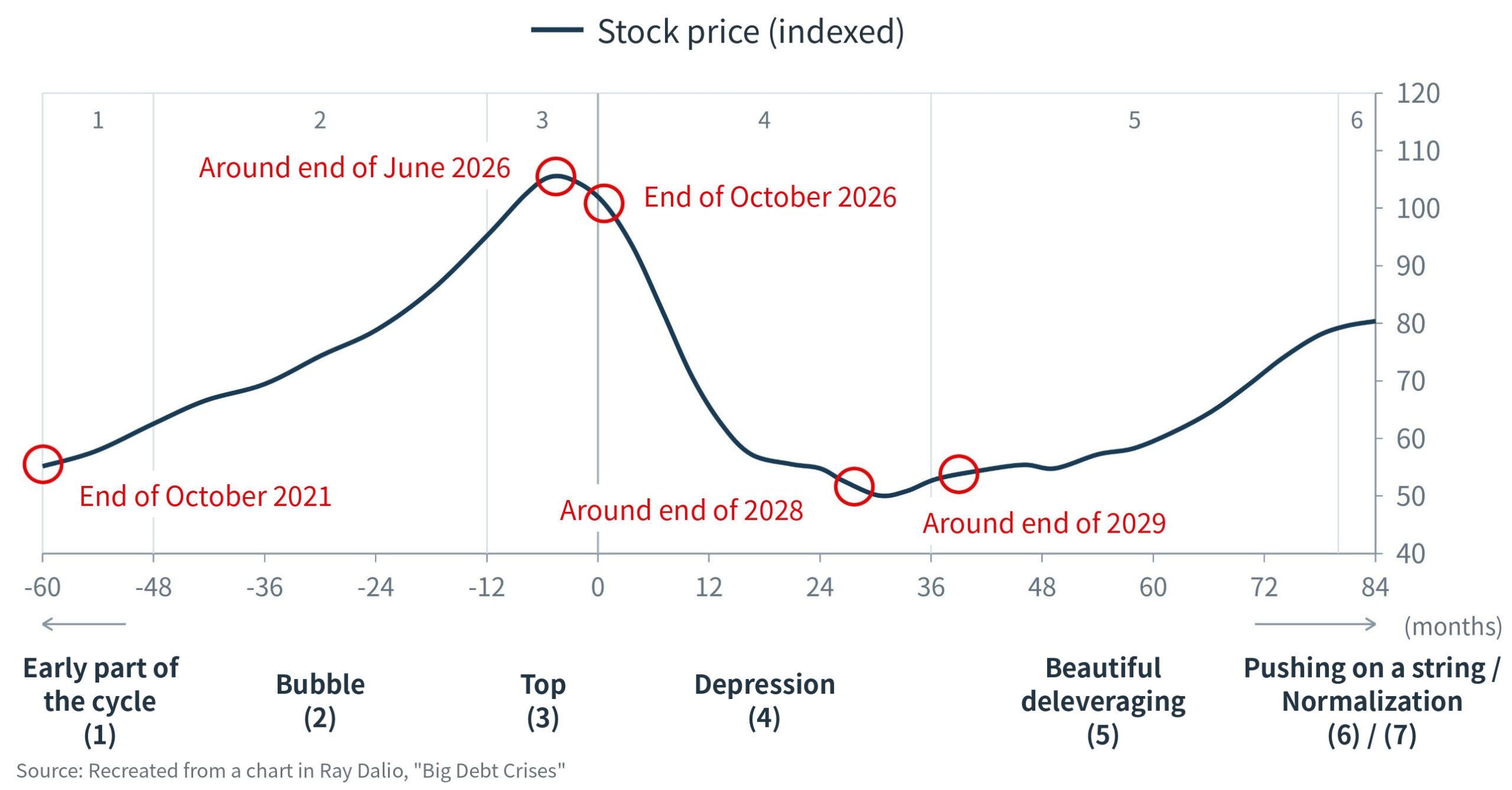
In an essay in early November I wrote that, with fairly high probability, the AI bubble had begun to burst.
- Essay: stocks peaked in the summer of 2026, and the AI bubble began to burst at the end of October (in Japanese)
I gave three grounds. First, all seven of the bubble conditions Ray Dalio lists in Big Debt Crises are met. Second, with stagflation in view, rate cuts are difficult, and both the US and Japan are raising rates. Third, the mechanism: the value of AI is not being rejected. Share prices that became too high relative to future cash flows give way in a chain of selling for cash. The value is real and the price is wrong. The spine of this article was already there in that essay.
The peaks differ by index. The Nikkei 225 peaked in June (Jiji Press), the Dow on August 5 (Macrotrends) and TOPIX on August 14. The S&P 500 and the Nasdaq Composite hit their highs on October 6 (CNN). Japanese stocks and the Dow topped out in the summer, and US technology stocks in the autumn.
After the essay was published, the market moved in the direction it described.
- November 19: Anthropic went public. It raised about $81.3 billion, the largest IPO on record (Forge). The selling across AI stocks did not stop.
- November 20: US stocks fell sharply. The S&P 500 fell 3.7% to 6,910.39 and the Nasdaq Composite fell 5.3% to 22,617.73. The S&P 500 entered a correction, more than 10% below its high, and the Nasdaq turned negative for the year (AP).
- The same day: the Nikkei fell 3,007 yen. It closed at 56,436.65, the fifth-largest point drop on record (OANDA Japan).
- Monetary policy is tightening. The FOMC minutes released on November 18 showed that almost all members saw further rate increases as possible.
5. Funding loops in the AI ecosystem and the risk that cash runs out
Whether the bubble ends in a correction or a collapse will be decided by funding more than by share prices. We update and publish, every month, a map of how money moves among AI companies.
The base is the IMF’s October 2026 Global Financial Stability Report. Across 14 deals since 2023, it counts about $300 billion of equity invested in AI companies, about $1.4 trillion of future revenue commitments running from AI companies back to those investors, and about $650 billion of debt. The basic loop is simple: invest in an AI company, and that company buys the investor’s own GPUs and cloud services with the money. In 2026, debt arranged through guarantees and special-purpose vehicles was added on top.
The risk is concentrated in OpenAI and Anthropic. By our reading, Anthropic had quarterly revenue of $11.6 billion against about $417 billion of future compute payment commitments. OpenAI expects to spend $750 billion on compute through 2030. If revenue does not catch up with these commitments, write-downs, repayment trouble and unmet revenue commitments arrive together.
In November the two companies took different paths. Anthropic secured funds through its IPO. OpenAI’s CEO Sam Altman said in September that its listing plans had been delayed (NPR). If public markets stay shut in 2027, the question will be who provides the new money that keeps the loop going. This loop supports the mistaken price, and it is also a sign of skewed distribution. Huge sums circulate among a handful of companies and seldom reach beyond them. The mapping of companies in our diagram, and some of the amounts, are our own estimates.
Analysis: looking ahead to 2027–2028
The analysis follows the two corrections in turn. The first half is the price correction, which happens in the markets. The second half is the distribution correction, which happens in politics.
The price correction: with the Trump administration weakened, from the bursting of the AI bubble to the Great Transition
A wrong price is corrected sooner or later. The question is how deep the correction goes. A bubble has begun to give way, and politics can no longer hold it up. I think this is the biggest reason the fall of 2027 and 2028 will be deep.
The midterm elections of November 3 changed the balance of seats in Congress. As of Nov 21, 5:39pm PT, AP’s count shows Democrats with 257 House seats won and Republicans with 173, and in the Senate a total of 56 for Democrats and 44 for Republicans. Five House seats are counted as won for no party in the AP results I have, and those results do not say why or which way those seats will go. The label “Majority reached” beside the Democrats in the House, and “Control reached” beside the Democrats in the Senate, is not a call by AP. These figures may have changed since then.
The president’s approval is also low. An Emerson College poll taken November 14 to 16 found 37% approving and 54% disapproving.
I see three ways this reaches the market.
- Fiscal policy cannot hold prices up. Tax cuts and rescue measures have to pass Congress, and it will be harder for the administration to pass them in the form it wants.
- Monetary policy cannot hold prices up. Inflation remains and the Fed is raising rates. Even if stocks fall, there is little room to answer with rate cuts.
- Favorable treatment of AI will not last. In the same poll, voters’ top priorities for Congress in 2027 were the cost of living (57%), ending the war in Iran (49%) and regulating the AI industry (37%). Political attention has moved from promoting AI to regulating it and to protecting household budgets.
The president keeps the veto, executive orders and authority over trade and foreign policy. Weakened does not mean powerless. It means that the market’s assumption that the administration will prop up stocks in the end no longer holds.
Stocks fall below half their peak
These are the targets in this article.
| Index | Record close | Close on Nov 20 | Fall so far | Target |
|---|---|---|---|---|
| Nikkei 225 | 72,366.34 (Jun 25) | 56,436.65 | 22.0% | 30,000 (about 59% below the high) |
| TOPIX | 4,197 (Aug 14) | 3,674.22 | 12.5% | 2,000 (about 52% below) |
| Nasdaq Composite | 27,599.89 (Oct 6) | 22,617.73 | 18.1% | About 13,800 (half the high) |
| Dow Jones Industrial Average | 54,349.12 (Aug 5) | 48,147.33 | 11.4% | About 32,600 to 38,000 (30 to 40% below) |
Highs and closes for the US indexes are from Macrotrends (Nasdaq, Dow). I expect a smaller fall in the Dow because technology stocks carry less weight in it.
Reaching these targets would take a further fall of about 47% in the Nikkei and about 39% in the Nasdaq from here. That is a long way off today. I still use these levels because past bubbles ended on that scale. The S&P 500 fell 49% in 2000-2002 and 57% in 2007-2009 (Fox Business). The Nasdaq Composite fell about 78% in 2000-2002 (Walnut).
Not only stocks: forced selling spreads, and yields stay high
Stocks will not be the only thing to fall. I expect real estate, cryptocurrencies and gold to fall as well, with selling for cash continuing.
The signs are already there. On November 20, gold fell to around $3,500 an ounce, its lowest since September 2025 (Kitco). Since October, gold is reported to be down about 15% and bitcoin about 28% (a summary of CoinDesk’s report). Gold is supposed to be a refuge. It is being sold anyway because investors are turning whatever they can sell into cash, to cover losses and meet margin calls. Assets bought with borrowed money feel this pressure most. Real estate moves later because deals take time, but if stocks keep falling and rates keep rising, I expect it to go the same way.
The other risk is that bond yields stay high. In an ordinary recession, government bonds are bought as stocks fall, yields come down and that supports the economy. This time there is a concern about stagflation, with prices rising while growth slows. Central banks will find it hard to cut rates, and growing fiscal deficits make buyers of government bonds cautious. On November 20, bonds were bought as stocks fell and yields edged down. Even so, the US 10-year yield was 4.94% and Japan’s 10-year yield was 2.785% (Nikkei). A year earlier Japan’s 10-year yield was around 1.8% (JGB yield history). I see a high risk that bond yields stay elevated.
Stocks, real estate and gold fall, and interest rates do not. In that case, investors carrying debt have nowhere to go but cash. Selling leads to more selling, and the decline drags on.
On the view that this ends as a correction
The opposite view has real grounds. Demand for AI exists, and Google Cloud revenue is up 103% year on year. Unlike in 2000, the companies doing the investing earn very large profits. If the fall in stocks spreads to the real economy, the Fed may stop raising rates. If so, this decline ends as a large correction.
But whether the value is real and whether the price is right are separate questions. I keep collapse as my main scenario because the funding loop described in item 5 is too large relative to actual revenue. Even if demand is real, funding fails if revenue does not arrive in time to meet the promised payments. Rate increases and the absence of political support come on top of that.
Collapse speeds up the transition
I expect events in this order.
- Late 2026 to the first half of 2027: a funding wall. Higher rates and lower stock prices thin the loop of equity and debt that has paid for AI investment, and cuts to capital spending plans begin.
- 2027: the real economy. Slower data center investment spreads to semiconductors, power, construction and the lenders, and real estate prices fall.
- 2028: a search for the bottom, and the political season. Stocks look for a floor around the target levels, and the US presidential election sets the direction of the next order.
The Great Transition was already under way. The bursting of the AI bubble does not stop it. It strips away, all at once, the money and expectations that were still attached to the old assumptions. AI itself will remain and take root after the speculative excess, as railways and the internet did. What gets corrected is the price, not the value.
What it means for Japan
Japan faces three pressures at once.
- Interest rates. The Bank of Japan’s policy rate is 1.25%, and the market expects another increase in December. Households and companies that borrowed to buy stocks and real estate face falling asset prices and heavier repayments together.
- The “2027 cliff”. The time to renew core systems coincides with falling stocks and rising rates. Stopping that investment now would further delay standardized operations and data foundations, which are the basis for using AI.
- Politics. The next House of Councillors election must be held by July 2028. If asset prices keep falling and prices keep rising, questions of distribution and burden will move to the front in Japan as well.
The distribution correction: will the next administration be moderate and centrist, or radical left?
After the price correction comes the distribution correction. The gains from AI and rising asset prices went mostly to people who own a lot of stock and to a few companies. Meanwhile the share going to working people shrank, and jobs for the young came under pressure.
Data on the skew in distribution
| Measure | Figure | Source |
|---|---|---|
| US stock ownership | The wealthiest 1% of households own about half of all stocks, and the top 10% own 88% | Fed distributional data (Yahoo Finance) |
| US labor share | 52.8% in the second quarter of 2026, the lowest since the series began in 1947. It was 62 to 64% in 2000 | US Bureau of Labor Statistics |
| US consumer spending | The top 10% of earners account for nearly half of spending (2025, a record) | Moody’s estimate (U.S. Bank) |
| US market concentration | Seven large technology companies make up about a third of S&P 500 market value. The record was about 35% in June | Institutional Investor |
| US young workers | Unemployment among recent college graduates (ages 22 to 27) was 5.7%, against 4.1% for all workers (June 2026) | New York Fed (NPR) |
| Japanese market concentration | Seven AI and semiconductor companies added 110 trillion yen of market value from the start of the year, more than half of the 218 trillion yen gain for the whole TSE Prime market. The other 1,500 or so companies rose 10% (as of June 18) | Nikkei report (summary, in Japanese) |
Three things stand out.
- The benefit of rising stocks goes to those who own them. In the US the top 10% hold nearly nine-tenths of stocks, and the top 10% of earners do nearly half the spending. The rise in AI-related shares lifted the assets of the people at the top first.
- The share going to working people has shrunk. The portion of business output paid to workers as compensation is the lowest on record in the US. Unemployment among young graduates is higher than for workers as a whole.
- The rise in stocks is itself concentrated in a few companies. In both the US and Japan, around seven companies produced most of the gain in the indexes. This is the same pattern as the funding loop in item 5.
This structure also links to the price correction. Stocks make up 48.2% of the financial assets of US households, a record and well above the 38.7% of the dot-com peak. If share prices fall, spending by the group that does half of all consumption shrinks, and the whole economy feels it quickly.
Some caveats. The fall in the labor share has been under way since the 2000s, and AI is not its only cause. On youth unemployment, some research puts more weight on factors other than AI. The spending figure is a private estimate. Even so, I am confident that the AI boom pushed this skew further in the same direction.
Japan is somewhat different. Real wages rose 2.2% year on year in September, the ninth straight monthly gain (Nikkei). Wages are improving. The skew in Japan shows inside the stock market, and between people who own stocks and people who do not.
When the bubble bursts, this skew becomes visible to everyone. Voters will look to politics for an answer. The character of the next administration will decide what form the distribution correction takes.
Once the US presidential election of November 7, 2028 decides the next administration, the broad direction will be set. Markets will start pricing the outcome from 2027, when the selection of candidates begins in earnest.
For now the Democratic field has no clear front-runner. In Emerson College’s November poll, Senator Jon Ossoff had 17%, former Vice President Kamala Harris 16%, Representative Alexandria Ocasio-Cortez 15%, Pete Buttigieg 14% and Governor Gavin Newsom 11%. On the Republican side, Marco Rubio had 44% and Vice President JD Vance 24% (Emerson College Polling).
| Scenario | Likely economic policy | What it means for stocks |
|---|---|---|
| A. A moderate, centrist Democratic administration | Fiscal discipline with selective redistribution. Both regulation and promotion of AI | Policy becomes predictable again, which helps a floor to form |
| B. A radical-left administration | Higher taxes on the wealthy and large corporations, more redistribution to middle- and lower-income households, tighter regulation of big tech | A further drag on corporate profits and valuations |
| C. A continued Republican administration | Tax cuts and deregulation maintained | Neutral to positive in the short run. The deficit and interest-rate problems remain |
I think the deeper the damage to stocks and jobs, the more likely scenario B becomes. The losses from the bubble will reach the middle class, and it will become plain that the benefits of AI and asset prices were concentrated in a few hands. In the same poll, the cost of living was voters’ top priority for Congress (57%). That favors candidates who campaign on redistribution.
A crisis does not always favor the left, however. Kohei Saito, whom I discuss below, also observes that anxiety over AI, war and inequality has raised distrust of established elites and strengthened hopes placed in populists (Newsweek Japan). Anxiety can turn toward calls for exclusion as well as calls for redistribution.
Not only the United States: toward changes of government worldwide
Elections follow one another in major countries through 2027 and 2028 (dates for Europe and South America from RankiaPro, as of October 5).
| Country | Election | When | What to watch |
|---|---|---|---|
| Spain | General election (early) | November 29, 2026 | The center-right People’s Party leads in the polls |
| France | Presidential election | April 18 and May 2, 2027 | President Macron cannot run. The National Rally leads |
| Argentina | Presidential election | October 24, 2027 | A verdict on whether Milei’s reforms continue |
| Poland | Parliamentary election | By November 11, 2027 | The Tusk government against a conservative president |
| Italy | General election | By December 2027 | The Meloni government’s term ends |
| Japan | House of Councillors election | By July 2028 | How voters judge the government amid falling stocks and rising rates |
| United States | Presidential election | November 7, 2028 | The direction of the next order |
Changes of government will not all point the same way. In Europe, the forces now ahead are mostly on the right and conservative side. A worsening economy brings incumbents down, but which way they fall differs by country. Discontent over distribution is shared, but whether the left or the right picks it up depends on the country. Many countries will move in many directions. I think we are entering a period in which each of them needs to be watched closely.
What happens if the radical left takes the White House
The radical left is the force that would push the distribution correction hardest. If it forms an administration, taxes on the wealthy and large corporations will rise and redistribution to middle- and lower-income households will expand. My view is that stocks would then head lower still, while concern for the global environment and moves toward world peace would gather pace little by little.
There are three ways it pushes share prices down.
- Higher corporate tax. After-tax profit falls, so share prices fall even at the same price-to-earnings ratio.
- Heavier taxation of the wealthy. The buying and selling behavior of the largest holders of stocks changes.
- Regulation of big tech. Tighter antitrust and AI regulation acts directly on the margins of the companies that have led the indexes.
This pressure comes on top of prices already brought down by the bursting of the bubble. Recovery will be slow, and the assumption that holding stocks always pays off will be shaken.
There are forces working the other way. Redistribution supports spending by middle- and lower-income households and helps companies that depend on domestic demand. A large tax increase needs a majority in Congress, and campaign promises do not become law unchanged. With high debt and high interest rates, there is limited room to fund redistribution by issuing bonds. A left-wing administration does not automatically mean lower stocks.
What I hope for in this scenario lies outside share prices. Climate breakdown is the first of the six macro risks and the ground on which the other crises worsen. Ending the war in Iran ranks high among the priorities US voters set for Congress (49%). If an administration puts environmental and security stability ahead of short-term shareholder gains, progress will come, little by little.
Here too I add a caveat. When energy prices are high, decarbonization policy collides with the cost of living. Competition with China is a bipartisan line. A left-wing administration does not by itself deliver the environment or peace. That is why I write “little by little”.
Will a shift begin toward the “dark socialism” of Kohei Saito’s new book?
Beyond the rise of the radical left, I see the argument that takes the question of distribution to its root: what Kohei Saito calls “dark socialism”. Saito published Hitoshinsei no “Mokushiroku” (roughly, The “Apocalypse” of the Anthropocene; Shueisha) in April 2026. What follows is my own understanding, based on a dialogue published by his publisher (Shueisha, in Japanese) and an interview (Shupure News, in Japanese). The English renderings of his terms are mine.
What “dark socialism” means
Why “dark”. The starting point is the recognition that climate breakdown has passed the point of return, and that catastrophe is something already happening and no longer something to be avoided. A “permanent scarcity economy” arrives, in which food and other goods are chronically short and growth cannot continue. The faith in progress, the belief that the future will be better, is set aside for now. “Dark” names the stance of facing that premise squarely. It does not endorse despair or nihilism.
What it stands against. Another current starts from the same dark view of reality and reaches the opposite conclusion. This is the anti-democratic “Dark Enlightenment”, which accepts rule by a technology elite. Saito describes a “fascism of the chosen”, in which people anxious about scarcity cast others aside to get into the group that is saved, and a “techno-fascism” that keeps an unstable society down through surveillance and exclusion using AI and robots. Dark socialism shares the diagnosis and refuses the conclusion. It keeps democracy and looks for a way to survive together.
The content is “democratic planning”. Saito’s view is that leaving things to the market produced inequality, financial crises, digital monopoly and environmental damage. He argues that the economy must be socialized and planned, with the state at the center. He clearly rejects the Soviet model, which imposed uniform plans through quotas and surveillance. His planning is one in which experts, citizens, consumers and workers take part in decisions, and limited resources are shared with priority given to what is essential for living.
The intent. This is a proposal of hope. If we cling to the world of capitalism as it has been, society divides and moves toward rule by force. Accepting that it is ending is what opens the possibility of a different society. The aim is to prepare for the moment when the crisis is real to everyone, and to show the path beyond it in advance. That is how I understand the term.
Where it meets the American radical left, and where it does not
There is common ground. Saito himself cites the election of a democratic socialist as mayor of New York, and that mayor’s plans for free infant and toddler care and city-run grocery stores, as an example of what is possible. He also argues for a left populism that connects the left with working people.
There is also distance. The American left has campaigned for higher taxes, redistribution and investment in the environment. It does not reject economic growth as such. Saito, who argues for degrowth and planning, stands further on.
Still, the direction is the same: from an economy that puts shareholder value first to one that puts the basis of everyday life and the global environment first. If the bursting of the bubble brings asset prices down sharply and an administration committed to redistribution comes to power, I think a shift in the direction of dark socialism may begin.
Reset once, and rebuild
In this era, I think an effort to reset once and rebuild into a new society and economy is a legitimate option.
I do not mean that I wish for collapse. The old assumptions are already breaking. I believe the long-run loss is smaller if we admit that they no longer hold and redesign, than if we prolong them through the power of asset prices. The same is true of corporate transformation. Our “Death of SaaS” series showed that only the company that cut unprofitable work, sorted its operations and decided not to go back succeeded in rebuilding itself.
The cost of a reset is not shared equally, though. When asset prices fall, pension assets shrink, jobs are lost and households that borrowed to buy assets run into trouble. People with thin savings are hurt first. Anyone who calls rebuilding a legitimate option has to think through who is supported, and how, during the transition.
Who is AI for?
Saito rejects the view that technological innovation alone can carry us past the crisis. He also warns that AI and robots can become tools of surveillance and exclusion. Our company holds that AI can raise white-collar productivity by a large margin. At first sight the two positions look opposed.
Where we part from Saito is on the value of AI. We think the value of AI is real. But we share the question of distribution: who receives what AI produces, and who sets the rules. Our at.AI Principles include “hand over the task, not the responsibility” and “do not confuse price with value”. People and organizations decide how far to rely on AI, and what should be measured is the value created, not the share price.
During the bubble, the value of AI was claimed in advance as asset prices and passed into a limited number of hands. What remains after the price is corrected is the value itself. Can we connect it to the productivity of working people and of society, and share it widely? I believe that is what will decide whether the Great Transition succeeds.
Conclusion: what to watch on the way to 2027–2028
The value of AI is real, and what is wrong is its price and its distribution. From that one point I have looked ahead to 2027 and 2028. The price correction proceeds in the markets and the distribution correction in politics. Whether this view is right can be checked at the following points.
| When | What to watch | What it tells us |
|---|---|---|
| December 2026 | FOMC (8th and 9th) and the Bank of Japan policy meeting (18th) | Whether tightening continues even as stocks fall |
| Every month | Our Macro Risk Monitor | Whether financial stress turns up from its low level |
| Every month | Our AI ecosystem analysis | Whether the loop of equity, debt and revenue commitments thins |
| Ongoing | Long-term yields, gold, cryptocurrencies, real estate prices | Whether forced selling spreads, and whether yields stay high even as stocks fall |
| 2027 | Whether OpenAI can go public | Whether public markets can absorb the funding needs of AI companies |
| From 2027 | Elections around the world and the US candidate selection | The direction of changes of government, and whether support grows for candidates who campaign on redistribution |
| November 7, 2028 | US presidential election | The direction of the next order |
Nobody can time a crisis exactly. What matters is to be prepared so that no scenario is fatal. For individuals that means liquidity, more than one source of income and the ability to use AI well. For companies it means standardized operations, a data foundation and the capacity to put AI into practice. When prices fall, value does not disappear. What remains after the bubble is stripped away will be the organizations that turned AI into real productivity.
This article is general information and the author’s personal view. It does not recommend buying or selling any security or asset. Market prices and poll figures are as of November 20 and 21, 2026.
Sources
- US stocks: AP (Nov 20), CNN (Nov 20), Macrotrends (Nasdaq, Dow)
- Japanese stocks: OANDA Japan (Nov 20), Jiji Press (Jun 25)
- Past bear markets: Fox Business, Walnut
- Gold, crypto and yields: Kitco (Nov 20), summary of CoinDesk’s report (KuCoin), Nikkei, Japan 10-year yield, JGB yield history, MogWatch, BOJ policy rate outlook
- AI companies: Forge, Anthropic IPO, NPR (Nov 21)
- Politics: Emerson College Polling (Nov 19), RankiaPro, 2027 election calendar. Seat counts for the US Congress are AP’s count
- Distribution: US Bureau of Labor Statistics, labor share, Yahoo Finance, household stock holdings (Oct 24), U.S. Bank, the K-shaped economy, Institutional Investor, market concentration, NPR, recent graduates (Aug 18), summary of Nikkei’s report on Japan’s seven, Nikkei, real wages
- Kohei Saito: Shueisha dialogue, Shupure News, Newsweek Japan (all in Japanese)





コメント